


Oil Prices Rise on U.S.-Iran Tensions
 Web Desk
|
21 hours ago
Web Desk
|
21 hours ago

Oil prices rose on Thursday as investors worried about escalating tensions between the U.S. and Iran. Brent crude futures increased 34 cents, or 0.49%, reaching $69.74 per barrel at 0126 GMT. Meanwhile, U.S. West Texas Intermediate crude rose 37 cents, or 0.57%, to $65.00. Both benchmarks had already closed higher on Wednesday, with Brent gaining 0.87% and WTI climbing more than 1.05%. Market fears over U.S.-Iran relations outweighed concerns about rising U.S. crude inventories.
U.S. President Donald Trump said he and Israeli Prime Minister Benjamin Netanyahu reached no “definitive” agreement on Iran. He emphasized that negotiations with Tehran would continue. On Tuesday, Trump suggested sending a second aircraft carrier to the Middle East if talks fail. U.S. and Iranian diplomats recently held indirect talks in Oman. Officials have not yet announced the date or venue for the next round of negotiations.
Analysts said oil prices could rise further if Middle East tensions escalate. IG analyst Tony Sycamore noted that a sustained break above $65–$66 in WTI requires more conflict. Conversely, any de-escalation could trigger profit-taking and push prices back toward $60–$61. Investors are closely watching the region as geopolitical events heavily influence oil markets.
Read more : Gold Prices Surge Sharply After Recent Decline
Economic signals from the U.S. also support oil demand expectations. U.S. job growth unexpectedly accelerated in January, and the unemployment rate fell to 4.3%. Mingyu Gao, chief researcher at China Futures, said the strong economy strengthens oil demand forecasts. Despite rising U.S. crude inventories, the market remains optimistic. Last week, U.S. crude stockpiles surged by 8.5 million barrels, far exceeding forecasts of 793,000 barrels.
Gao added that global oil inventory builds have generally been below expectations this year. Net long positions in overseas crude futures and options remain moderate. Tightened sanctions on Russian oil and expected lower exports support higher oil prices. Overall, the market likely remains biased to the upside, driven by geopolitical risks and steady economic growth.







2 hours ago
3 hours ago
4 hours ago
4 hours ago
6 hours ago
6 hours ago
- U.S. President Donald Trump has urged that Israeli Prime Minister Benjamin Netanyahu should be granted a pardon in his ongoing…
- Bangladesh has completed voting for its 13th national parliamentary elections, and vote counting is now underway across the country. The…
- U.S. President Donald Trump has warned Iran that failing to reach an agreement on its nuclear program could lead to…
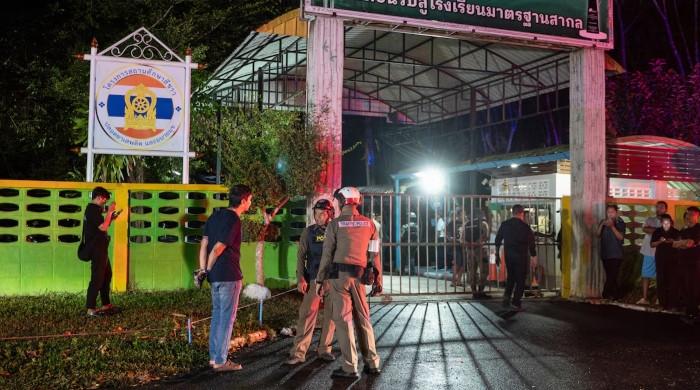
 A female teacher died in southern Thailand after a gunman opened fire at her school in Hat Yai district. The…
 LAHORE: Punjab Health Minister Khawaja Salman Rafique said the Chief Minister’s Children’s Heart Surgery Programme is a landmark initiative. It…
 Pakistan on Tuesday called on Organization of Islamic Cooperation (OIC) member states to strengthen collaboration in vaccine manufacturing. State Minister…
 The Pakistan Pavilion was inaugurated at the World Health Exhibition (WHX) 2026 in Dubai. The event ran from February 9…
 ISLAMABAD – The first national polio immunization campaign of 2026 has entered its fifth day. Over 42.2 million children have…





- U.S. President Donald Trump has urged that Israeli Prime Minister…2 hours ago
- Bangladesh has completed voting for its 13th national parliamentary elections,…3 hours ago
- U.S. President Donald Trump has warned Iran that failing to…4 hours ago
- The bodies of three Pakistani nationals who died in Iran…4 hours ago