


NASA unveils powerful Roman telescope for deep space exploration
 Rabbia Zafar
|
3 weeks ago
Rabbia Zafar
|
3 weeks ago
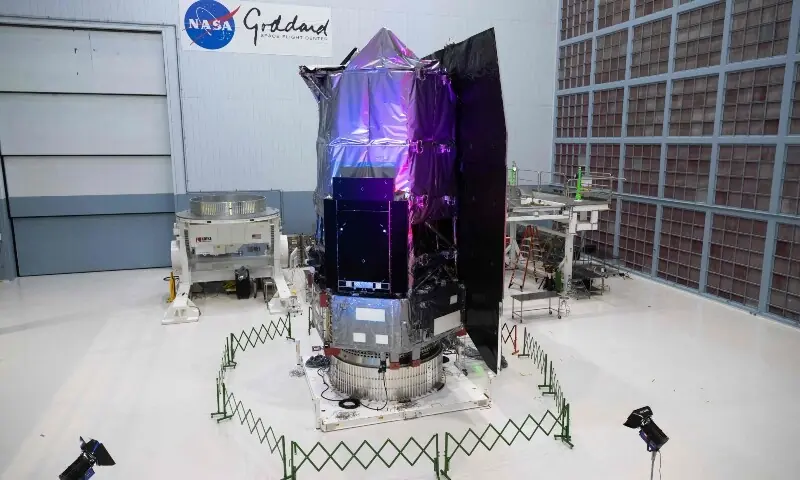
The NASA has unveiled its latest space observatory, the Nancy Grace Roman Space Telescope, designed to explore distant planets and unlock mysteries surrounding dark matter and dark energy. The announcement was made at the Goddard Space Flight Center in Maryland, where the telescope was presented to the public ahead of its planned launch later this year.
Named after pioneering astronomer Nancy Grace Roman, often called the “Mother of Hubble,” the telescope represents a major step forward in space observation. It has taken over a decade to build and cost more than $4 billion. The mission is expected to significantly expand humanity’s understanding of the universe.
Unlike its predecessor, the Hubble Space Telescope, Roman features a field of view at least 100 times larger, allowing it to scan vast areas of space more efficiently. Scientists say it will detect tens of thousands of planets beyond our solar system, as well as billions of galaxies and countless stars.
NASA Unveils Ambitious Plans for Moon Base and Nuclear-Powered Mars Mission
The telescope will operate from a distance of about 1.5 million kilometres from Earth, capturing detailed infrared images. This capability enables it to observe light emitted billions of years ago, effectively allowing scientists to look back in time.
Researchers are particularly hopeful that Roman will provide insights into dark matter and dark energy, which together make up about 95 percent of the universe but remain largely unexplained. Its findings are expected to complement observations from the James Webb Space Telescope and other global projects.
Experts believe the data gathered by Roman could reshape our understanding of cosmic evolution and may even lead to groundbreaking discoveries that redefine modern astrophysics.









2 hours ago
2 hours ago

2 hours ago
2 hours ago
3 hours ago
7 hours ago
- Democratic Congressman Ed Case acknowledged that the United States suffered major aerial losses during the war with Iran. According to…
- A political crisis appears to be deepening in the United Kingdom after the ruling Labour Party suffered major losses in…
- U.S. President Donald Trump strongly criticized American media coverage of the war involving Iran, the United States, and Israel. He…
- A British magazine has claimed that Russia offered Iran advanced drones that cannot be jammed through conventional electronic warfare systems.…
 Health authorities are working to contain a potential international spread of hantavirus after new suspected cases emerged across multiple countries,…
 The Indus Hospital, located in Karachi’s Korangi area, has earned widespread recognition for providing free and quality healthcare services to…
 The Healthcare Devices Association of Pakistan (HDAP) has raised serious concerns over the continued presence of banned reusable syringes in…
- Federal health authorities have ordered strict nationwide enforcement of a ban on conventional disposable syringes and initiated a policy review…




- South Indian actress Trisha Krishnan has once again become the…2 hours ago
- Democratic Congressman Ed Case acknowledged that the United States suffered…2 hours ago
- A political crisis appears to be deepening in the United…2 hours ago
- U.S. President Donald Trump strongly criticized American media coverage of…2 hours ago