


Aaqib Javed outlines major changes to Pakistan central contracts system
 Web Desk
|
2 hours ago
Web Desk
|
2 hours ago
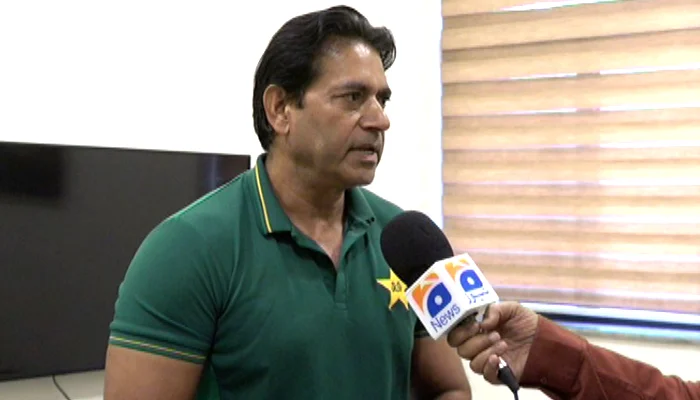
Pakistan Cricket Board (PCB) Director of High Performance Aaqib Javed has said that introducing separate central contracts for each format is a first step toward a major structural shift in Pakistan cricket.
Speaking to media in Lahore, he explained that Test, One-Day International (ODI), and T20 cricket will be treated as separate categories under the new system to ensure fair evaluation and workload management of players. He said that previously, players from different formats were compared unfairly, which affected performance assessments and financial rewards.
Aaqib Javed stated that under the proposed model, players will be rewarded strictly on performance within their respective formats. He added that top-performing Test cricketers could earn up to Rs4 million per month, while others may receive between Rs3 million and Rs3.5 million depending on form and consistency.
Anti-corruption court hears Rs8.5bn Yellow Line BRT scam case
He further explained eligibility criteria for contracts, saying that players must meet specific domestic participation requirements. For instance, those aiming for Test contracts will need to play at least six first-class matches, while combined Test and ODI players must participate in four first-class and four List A matches.
According to him, players in different categories will also have limits on No Objection Certificates (NOCs) for franchise leagues. Test players may receive permission for one franchise league, while white-ball specialists could be granted up to two.
The PCB official said the aim is to discourage players from spreading themselves across all formats without focus. “We want players to concentrate on their primary format and develop specialization,” he said.
He also acknowledged that changes in the T20 squad are inevitable, pointing out that performance and commitment in domestic cricket will play a key role in selection and contract continuation.
Aaqib Javed concluded that the system is designed to build a stronger pipeline of format-specific players and improve Pakistan’s overall performance, particularly in Test cricket, where consistency has been a concern.
Aaqib Javed outlines major changes to Pakistan central contracts system
Karachi sees surge in gastro and diarrhoea cases amid rising summer heat

Pro-Khalistan protest briefly disrupts Diljit Dosanjh concert in San Francisco

Anti-corruption court hears Rs8.5bn Yellow Line BRT scam case
Iran-US technical talks conclude in Switzerland with progress on framework agreement
India: Bride and her parents die by alleged suicide a day before wedding
Body found in parked car on Lahore’s Ring Road, police launch investigation


2 hours ago
2 hours ago
2 hours ago
2 hours ago

2 hours ago
2 hours ago
- A concert by Indian Punjabi singer and actor Diljit Dosanjh was briefly disrupted when a pro-Khalistan supporter entered the stage…
- Iran’s Deputy Foreign Minister and head of the Iranian technical negotiating team, Kazem Gharibabadi, has announced that the latest round…
- In a tragic incident in India’s southern state of Karnataka, a bride and her parents reportedly died by suicide just…
- Israeli military strikes in southern Lebanon’s Qatina area have brought Muslim and Christian communities closer, as displacement caused by ongoing…

 Karachi is witnessing a worrying surge in congenital heart diseases among newborns, with medical experts warning that thousands of children…
 Pakistan now has the highest diabetes rate in the world, according to the latest IDF report. The report shows that…
 South Africa, Eswatini, and Zambia have begun administering lenacapavir, a groundbreaking HIV-prevention injection, marking a major milestone in the fight…
 KARACHI: The Sindh High Court’s Constitutional Bench was informed on Monday that all milk samples collected in Karachi are harmful…





- Pakistan Cricket Board (PCB) Director of High Performance Aaqib Javed…2 hours ago
- Hospitals across Karachi are reporting a sharp increase in gastroenteritis…2 hours ago
- A concert by Indian Punjabi singer and actor Diljit Dosanjh…2 hours ago
- The United States has maintained a long and evolving sanctions…2 hours ago