


Remains of Mysterious Ancient Marine Predator Discovered in Canada
 Web Desk
|
1 year ago
Web Desk
|
1 year ago
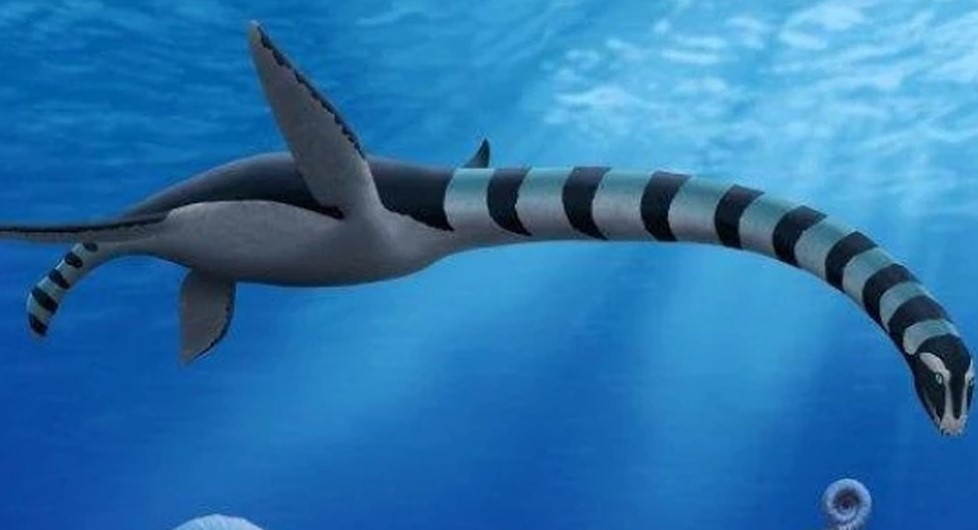
OTTAWA – Canadian scientists have discovered fossilised remains of an unusual and formidable marine predator that inhabited Earth’s oceans millions of years ago. This finding is outlined in a recently published study that identifies the creature as a new type of elasmosaur, a long-extinct group of marine reptiles.
Published in the Journal of Systematic Palaeontology, the research names the new species “Tlatolophus galorum”—a remarkable find that adds to our understanding of prehistoric marine life. The creature lived approximately 85 million years ago during the Late Cretaceous period.
Elasmosaurs were large marine reptiles recognised for their snake-like necks, powerful jaws, and long, sharp teeth, which rendered them formidable hunters in ancient seas. Their physical characteristics were perfectly adapted for catching, crushing, and consuming prey with great efficiency.
The newly identified species, Tlatolophus, is said to possess a unique combination of “primitive and derived traits” that set it apart from previously known elasmosaurs. This distinct mix of features gives researchers new insights into the evolutionary diversity within this group.
Both Tlatolophus and other elasmosaurs fall under the broader category of plesiosaurs, marine reptiles that existed from approximately 215 million to 66 million years ago, spanning the Triassic to the end of the Cretaceous period.

Aaqib Javed outlines major changes to Pakistan central contracts system

Karachi sees surge in gastro and diarrhoea cases amid rising summer heat

Pro-Khalistan protest briefly disrupts Diljit Dosanjh concert in San Francisco


Anti-corruption court hears Rs8.5bn Yellow Line BRT scam case

Iran-US technical talks conclude in Switzerland with progress on framework agreement

India: Bride and her parents die by alleged suicide a day before wedding

Body found in parked car on Lahore’s Ring Road, police launch investigation



54 minutes ago
54 minutes ago
1 hour ago
1 hour ago

2 hours ago
2 hours ago
- A concert by Indian Punjabi singer and actor Diljit Dosanjh was briefly disrupted when a pro-Khalistan supporter entered the stage…
- Iran’s Deputy Foreign Minister and head of the Iranian technical negotiating team, Kazem Gharibabadi, has announced that the latest round…
- In a tragic incident in India’s southern state of Karnataka, a bride and her parents reportedly died by suicide just…
- Israeli military strikes in southern Lebanon’s Qatina area have brought Muslim and Christian communities closer, as displacement caused by ongoing…

 Karachi is witnessing a worrying surge in congenital heart diseases among newborns, with medical experts warning that thousands of children…
 Pakistan now has the highest diabetes rate in the world, according to the latest IDF report. The report shows that…
 South Africa, Eswatini, and Zambia have begun administering lenacapavir, a groundbreaking HIV-prevention injection, marking a major milestone in the fight…
 KARACHI: The Sindh High Court’s Constitutional Bench was informed on Monday that all milk samples collected in Karachi are harmful…






- Pakistan Cricket Board (PCB) Director of High Performance Aaqib Javed…54 minutes ago
- Hospitals across Karachi are reporting a sharp increase in gastroenteritis…54 minutes ago
- A concert by Indian Punjabi singer and actor Diljit Dosanjh…1 hour ago
- The United States has maintained a long and evolving sanctions…1 hour ago